2022
Read the news
from 2030.
9:41
Monday, September 23, 2030
FOXFOX NEWSnow
Child starvation deaths declared effectively over.
Health officials confirm global treatment coverage for child wasting has crossed 95% and held. The public–private model proven in 2022 — and scaled by Operation End Starvation in 2026 — delivered what it promised. “Money in, children treated.”
Close ✕
The American Cure What We Deliver What It Costs The Roadmap Learn More
NO CHILD
SHOULD DIE
FROM A PROBLEM
WE CAN SOLVE
“As parents, it is our duty to nurture the next generation’s hope. As leaders, the responsibility to sustain our children extends beyond the comfort of a few.”— Melania Trump, UN General Assembly, 2025 “As parents, it is our duty to nurture the next generation’s hope. As leaders, the responsibility to sustain our children extends beyond the comfort of a few.”— Melania Trump, UN General Assembly, 2025
Scroll to continue ↓
The same fight, upstream

RUTF saves a child who's already starving.
MMS protects the next one before birth — the same fight, moved upstream.

American mothers have access to dozens of prenatal vitamin choices.

Millions of mothers around the world still don't have access to even one complete prenatal supplement.

Multiple Micronutrient Supplements (MMS)

What we deliver

One tablet a day. About $4 for a whole pregnancy.

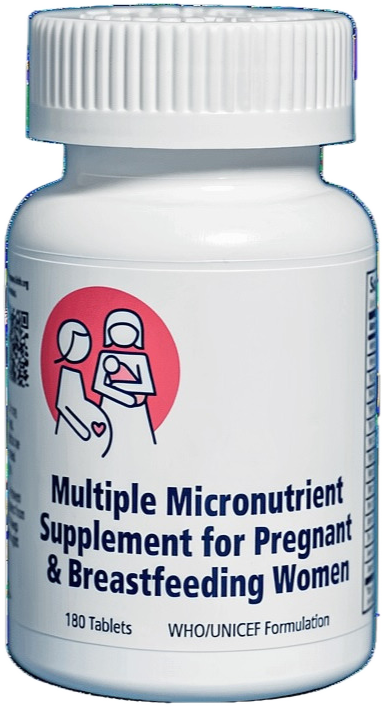
One MMS tablet gives a pregnant mother the vitamins and minerals she and her baby need through the months when a body and a brain are built.
15vitamins & minerals
1tablet a day
$4a whole pregnancy
MULTIPLE MICRONUTRIENT SUPPLEMENT · UNIMMAP · WHO / UNICEF FORMULATION ·
UNIMMAP Multiple Micronutrient Supplement bottle

Something we take for granted

Here, a prenatal vitamin is ordinary. A doctor recommends it, you pick it up at the pharmacy, and you take one a day without thinking twice.

For millions of mothers, that same tablet is out of reach — not because it costs too much or is hard to make. It just hasn't reached them yet.

Every mother deserves the same start we don't even think about.

What one $4 course does
12%Fewer low-birthweight births
14%Less stunting — the lasting damage to a child's growth and brain that early malnutrition leaves for life
30%Fewer newborn deaths among anemic mothers
29%Fewer maternal deaths

How it works

One tablet, taken daily, covers the 1,000-day window from pregnancy through a child's second birthday — when most of the brain and body take shape. Miss those months and the gap doesn't close later. Get the nutrition right, and a child starts life on solid ground.

The evidence

This is not new or untested. Research has been underway since 1999. There are now 19 clinical trials and data from 141,000 women.

The economics

Two cents a tablet. About $4 a pregnancy. Every $1 spent on MMS returns $2 in direct value and $37 across a lifetime — and when a government matches the funding, that climbs to 74 to 1. Few investments in global health pay back like this.

Where it stands

30 countries are adopting MMS as national policy. It is ready to be built into standard prenatal care anywhere.

For years the answer was
"too expensive."

So what would it actually cost?

The math: give MMS to every pregnant woman who already shows up for prenatal care — in the 25 countries where the most babies are born too small.

The return · up to
$0B
in economic value, every year
The cost / yr
$0M

That yearly cost is less than 3% of what the world already spends fighting undernutrition.

Every year, this would prevent

0Low-birthweight births
0Stillbirths
0Female newborn deaths
The verdict, 2026

"Too expensive"
is no longer true.

Cost measured in millions. Return measured in billions — between $7.19 billion and $107.67 billion. Source: Hoddinott et al., BMJ Global Health 2026;11:e020597.
The roadmap · 45 countries

Where the next mothers are.

These 45 countries carry more than 85% of the world's stunting, stillbirths and newborn deaths. The global investment roadmap charts a way to reach them all by 2030. Below: where MMS is needed, where scale-up already stands, and how heavily anemia weighs on each.

260M
mothers to reach by 2030, up from 16M a year today
618,000
lives saved — 411K stillbirths, 193K neonatal & 13K post-neonatal deaths averted
5.3M
vulnerable births averted — babies born too soon or too small
15.4M
cases of maternal anemia prevented
$1.1B
seven-year investment, 2024–2030, across all 45 countries

Why now

15 vs 2

MMS delivers 15 essential nutrients. The current standard in most low- and middle-income countries — iron and folic acid — delivers two. In anemic or underweight women, MMS cuts low birth weight by up to 19%.

58% 36%

Across 37 high-burden countries, 58% of women attend four or more antenatal visits — but only 36% receive 90+ days of supplements. Women are showing up. The system isn't delivering.

17% 60%

The roadmap ramps coverage from 17% of eligible pregnancies in 2024 to 60% by 2030 — from 16 million to 59 million women reached each year.

2 of 3

Two out of three women of reproductive age worldwide have micronutrient deficiencies. Malnutrition costs the global economy an estimated $3.5 trillion every year.

"At an average cost of $4 per pregnant woman reached, we impact two lives — mother and baby."

Healthier Pregnancies and Brighter Futures for Mothers and Babies — Global Investment Roadmap, May 2024
Sources: Healthier Pregnancies and Brighter Futures for Mothers and Babies: A Global Investment Roadmap for Multiple Micronutrient Supplementation (May 2024); scale-up phases and anemia prevalence from the Healthy Mothers Healthy Babies Consortium World Map (updated April 2026), health indicators via WHO. Impact modeling: Lives Saved Tool (LiST), Johns Hopkins Bloomberg School of Public Health. Prepared by 1 Life 1 World.

Save One
Whole World

Learn More →